
 Mike Deverell
React and rebalance
Executive summary
- News headlines can make short-term falls sound alarming, but global markets and portfolios remain up overall in 2026.
- Growth is broadening beyond the biggest tech stocks, with other parts of the US market performing well despite recent weakness in AI-related companies.
- A diversified approach can provide greater resilience when leading sectors experience a downturn.
- Volatility can create opportunities, with intelligent rebalancing allowing us to take profits from stronger assets and add to investments when prices fall.
“Global stocks plunge as fears over US AI slowdown spread to Asia and Europe.”
That was the top story on the BBC News website on 5 November, after the mid-term elections in the US.
Fewer headlines were made over the next few days, when many of those stocks recovered most of their lost ground!
As we’ve observed before, a headline such as “Trillions wiped off the value of pensions” makes good clickbait. That sounds like a hell of a lot of money for my pension to lose!
Rarely is there a headline saying, “Trillions added to the value of stock markets!”, mainly because that growth tends to happen more slowly over time.
For context, the market capitalisation of the MSCI All Companies World Index (a proxy for global stock markets) has grown by about $11 trillion US dollars this year (Source: MSCI / Gemini to end October). Markets (and portfolios) are all nicely up in 2026 so far.
However, on 5 November, the Nasdaq index which comprises of mainly tech stocks fell about 5.5%, with the wider US market (the S&P 500) falling about 4.3%.
That may sound like a lot, but we should remember that even in good years markets often have periods when they’re falling sharply. We usually tell clients to expect a double-digit fall in stock markets in most years, even in years when the market goes up.
In fact, a lot of the time, media headlines can be a contrarian indicator. There have even been studies which show that when magazine covers are negative about an asset class, it tends to go up over the subsequent period. When they are bullish, the asset class tends to go down.
Sometimes, it pays to do the opposite of what the headline might suggest.
Weirdly reassuring?
In some ways, this last week has been weirdly reassuring.
One thing we’ve been concerned about, is that markets have become more and more concentrated in AI and tech-related stocks. This is particularly true in the US and in emerging markets, where the tech stocks make up a big proportion of the index.
A concentrated market is great when that sector is performing well, but not so good when things turn. We like to be much more diversified where possible.
However, what’s been pleasing over the past month is how well certain markets have done despite the fall in tech stocks.
Chart one shows the returns of various parts of the US stock market over the past month. We rarely show such short-term moves, but this is shown to illustrate the resilience of parts of the market.
The green line is the so-called “Magnificent Seven” tech stocks, down about 7% over the period. That has dragged down the S&P 500 index in red, which has fallen about 3%. The S&P 500 is a market-cap weighted index, so the bigger the company, the bigger the weight in the index.
The blue line is the equal weight S&P 500 index, which is up nearly 4% over the same period. It contains the same companies as the main S&P 500 but weights them equally, giving smaller companies the same weighting as larger ones.
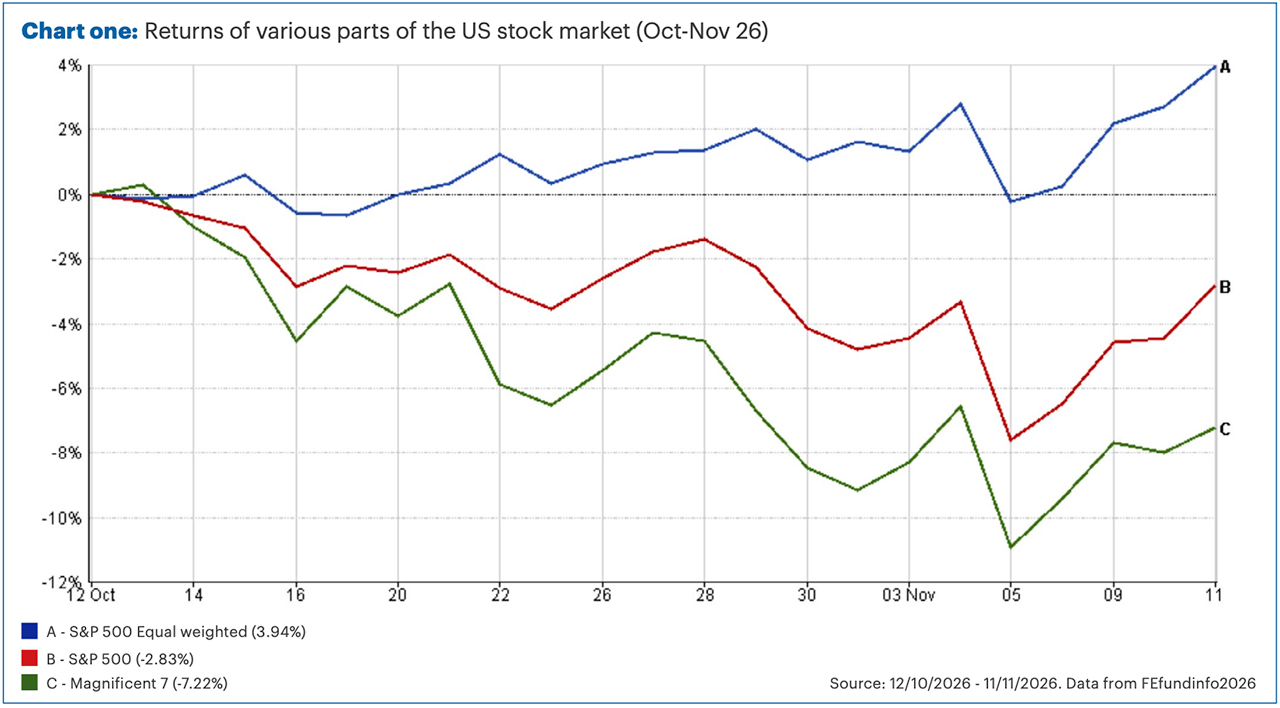
The figures suggest that growth in the stock market has broadened out somewhat. Lots of different types of companies and sectors outside of tech are doing well at the moment, and they’re not so vulnerable to an AI backlash. In the Equilibrium portfolios, we hold a fund that tracks the equal weight index as well as the usual US market to try and capture this broader growth.
Why the sell-off?
As Chart one shows, tech stocks (the green line) were already falling before the early November election.
Several of the big tech stocks had reported earnings over that period and seen their share prices fall. In some cases, the earnings have been a bit disappointing, and in other cases, there are worries about just how much money is being spent on AI.
There has also been something of a backlash against AI in the United States. The Republicans are seen as very pro-tech, and the Democrats are seen as more likely to regulate and tax the tech companies.
In particular, many people really hate the data centres which are being built to power the AI models. These can have a real impact on the local environment and use a lot of power and water.
At the same time as the midterms, in various US regions there were 41 data centre-related resolutions on ballot papers. According to CNBC, 40 out of the 41 saw a vote against data centres.
Buy the dip
One of the keys to a successful investment strategy, is regular rebalancing.
Let’s assume you started with a simple asset allocation of 50% cash and 50% in the stock market. Imagine it’s a great year for markets, and stocks go up 25%. Ignoring interest on your cash, your portfolio would now have around 56% in equity.
This means your portfolio is now riskier than it was at the start, and therefore if stocks fall you would experience more of a drop.
It is therefore important to rebalance your portfolio regularly, banking the gains you’ve made and reducing that risk.
One of the benefits of the Equilibrium portfolio structure is the ability to react quickly. We try to make volatility our friend, by what we call “intelligent rebalancing”. When we get major down days, that’s often a good opportunity to rebalance, selling some of the things that have held up well, buying the things that have gone down, and hopefully benefitting from a rebound.
If you read The Pulse September edition, you may recall we were discussing a rise in bond yields (meaning a fall in bond prices).
We used that weakness in bonds as an opportunity to top up gilt exposure. We did so in some of our portfolios by buying a structured product from Goldman Sachs, which they have created bespoke for our clients.
This product can run for up to 5 years and is based on the 10-year gilt. For every quarter the gilt yield is below 6.5%, the product pays a quarterly coupon equivalent to 9.45% p.a. At the end of the 5 years, we’ll be repaid the capital.
For context, the current yield on the gilt is 5.2%, having dropped from around 5.4% at the time we bought it (Source: LSEG Datastream). The 10-year gilt yield has not been above 6.5% since 1997.
We think this is a great way of benefiting from attractive gilt yields, and because gilt yields have dropped since we bought it, the product has already made a gain.
When we saw the dip in stock markets last week, we were able to sell some gilts and use that to top up equities at the lows.
Put simply, regular rebalancing ensures you sell high and buy low.
Having the ability to act quickly and decide on the timing of that rebalancing, can help add to returns and reduce risks over the long term.
Past performance is for illustrative purposes only and cannot be guaranteed to apply in the future.
This newsletter is intended as an information piece and does not constitute investment advice.
If you have any further questions, please don’t hesitate to get in touch with us on 0161 486 2250 or reach out to your usual Equilibrium contact.
New to Equilibrium? Call 0161 383 3335 for a free, no-obligation chat or contact us here.