
 Mike Deverell
Shaken, not stirred
Executive summary
- Government bond yields have risen sharply, but it doesn’t automatically mean huge losses as headlines suggest.
- The yield available when a bond is purchased is the main driver of its long-term return, making today’s higher yields potentially attractive for investors.
- Equilibrium generally favours corporate and short-dated bonds, which offer higher income and are less sensitive to changes in interest rates.
- Yields are rising because interest rates and inflation have remained higher than expected, while governments and companies are issuing more debt.
- Higher borrowing costs could eventually slow economic growth, so we will continue to monitor developments carefully.
Over the past few months, government bond yields have increased substantially. If you read the financial press, then you will have seen many alarming headlines recently, speculating why yields have risen so much, and what the implications are. Whilst this might not seem like the most exciting of topics for most people, this increase in yields could be significant for both governments and investors.
A government bond, such as a gilt, is a form of borrowing. When you buy a gilt – as we do within the fixed interest portion of our portfolios – we are lending money to the UK government. Most bonds are issued for a fixed period and provide a fixed level of interest. At the end of the term, the bond matures and the investor gets their money back. From an investment point of view, one of the attractions is the relative safety; a gilt is guaranteed by the government, so if you hold it to maturity the chance of not getting your money back is extremely small.
Whilst it’s a relatively safe investment, the yield on the bond still needs to be fairly attractive, otherwise investors could just leave their money in cash instead. This means that when interest rates move higher, bond yields need to move higher too.
When yields go up, prices go down
If you hold a bond until it matures, you know exactly what return you’re going to get. However, government bonds are actively traded, and you can buy or sell at any point during the term. This means the value of the bond can fluctuate substantially.
When we say that yields on bonds are rising, what this means is that the prices of the bonds are falling. This dynamic had a huge impact in 2022, when high inflation forced central banks to increase interest rates substantially. The 10-year gilt yield rose from about 1% at the beginning of the year to around 4.5% on 27 September 2022, just after the Liz Truss “Mini Budget”.
An investor in the 10-year gilt would have seen the value of their holding drop by about 23% over that period (Source for 10-year gilt data: LSEG Datastream). At the beginning of September 2026, the 10-year gilt yield hit about 5.25% – substantially higher than after the Mini Budget. Surely this increase in yields means that gilt investors have lost even more money since then?
In fact, someone holding a 10-year gilt on the day of the Mini Budget (22 September 2022) would have made about a 9% GAIN between then and 1 September 2026. This is because, whilst the price of the bond has gone down over that period, investors have also received interest payments. The total income paid out over that period is a lot more than the capital loss.
Over the long term, by far the biggest determinant of your return on a bond investment is the yield at the time you bought it. The capital fluctuations are merely short-term volatility. When we see these headlines, the implication is that investors are making huge losses. For the most part, that’s not the case.
At Equilibrium, we hold some government bonds in our portfolios, but we prefer corporate bonds generally. This is lending to companies, which is seen as riskier since companies are more likely to default on the loans. However, we get paid a higher yield to compensate us for taking that risk. We also prefer short-dated bonds, which have less time to maturity and therefore less risk of default. Importantly, they still provide a decent yield and also have the benefit of being less sensitive to fluctuations in interest rates.
From an investment perspective, bonds still look quite attractive in our view. In fact, the rising yield makes them potentially more attractive, particularly if you think the Bank of England may not hike interest rates as much as the market currently believes.
Why are yields rising?
This is the subject of a lot of speculation and, in reality, there are several reasons. It is important to note that this is a global trend and applies to the likes of the US, Japan and Europe just as much as the UK.
One of the main reasons is that interest rates around the world, which looked likely to be cut at the start of this year, have in fact been held or increased in many regions. This is partly because economic growth has been stronger than expected, particularly in the US where big-tech companies are investing a lot of money in artificial intelligence (AI).
Less positively, it’s also because inflation has been higher than expected, largely due to the impact of the conflict in the Middle East on commodity and energy prices. In addition, as with many assets, yields are being driven by the dynamics of supply and demand.
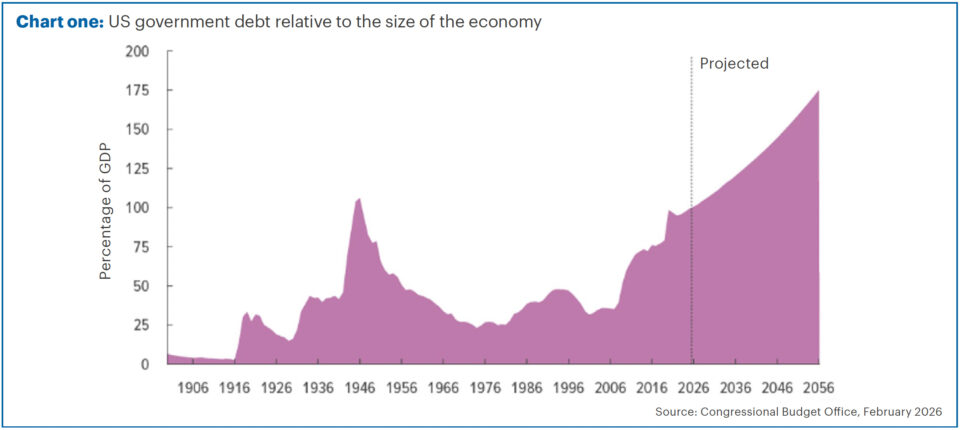
As we’ve covered previously, government debts in the Western world are already relatively large compared to their economies, and this is only likely to increase. This is partly due to demographics, with aging populations likely to mean higher welfare spending and pressure on tax revenues as a smaller proportion of the population are working.
Chart one shows this for the US government. As the largest economy this has the biggest impact on global bond markets, but a chart for the UK government would look similar. Debt is already at 100% of GDP and is projected to move to more than 150% of GDP over the coming decades. This would increase the supply of bonds which, unless matched by a similar rise in demand, could push yields higher.
There is also speculation that a greater supply of corporate debt, notably from the big tech companies as they try to finance their AI spending, is also having an impact. Whilst this represents hundreds of billions of dollars, this is still relatively small compared to the trillions of dollars of US government bond issuance each year. Still, these bonds are essentially targeted at the same investors, and so it may be having a marginal impact.
Economic implications
The rising cost of borrowing for governments could have many economic implications. Over the medium term, they may be forced to cut spending or to increase taxes, which could have a negative impact on economic growth. This is a difficult balancing act, since we measure debt relative to the size of the economy. One way to reduce your debt to GDP ratio is to ensure the economy grows more quickly than the debt!
Higher government bond yields also have an impact on borrowing costs elsewhere. Companies will have to pay a higher yield too, so that their debt remains attractive relative to government debt. This also means things like mortgage rates are higher than at the start of the year, and this could continue to increase. If companies and individuals find it harder or more costly to borrow, that could also impact growth.
At present, economic growth is relatively strong and therefore you could argue that higher borrowing costs are fine, and in fact potentially desirable (as it helps keep a lid on inflation). However, some argue that borrowing costs could soon reach a tipping point, prompting companies to rein in their spending plans. This could have a big impact since this has been one of the biggest drivers of growth.
In our view, there are several reasons for the increase in yield and not all of them are bad. As investors, we don’t mind higher yields since it means the future expected return from investing in bonds actually increases. We, of course, will be watching carefully and will be ready to act if necessary. However, as usual, it is really important not to take sensationalist headlines at face value – things are usually a lot more nuanced than headline writers would have you believe!
A quick personal note
This is the first newsletter I’ve drafted since Colin’s passing.
Colin was the original architect of our investment approach. As he explained it to me, he came up with our original growth assumptions and asset allocation, essentially on the back of a napkin. It just felt about right. When I joined 19 years ago, I spent a lot of time carrying out in-depth research and analysis on the historic returns of various asset classes, only to find that his instinct was annoyingly (and as usual) pretty much spot on!
Over time, the process evolved into the evidence-based strategy we run today, but its foundations remain broadly the same as the approach Colin devised all those years ago. In recent years, he was much less involved in the investment side, but I, and I suspect many others, always had a little voice in the back of my mind asking, “What would Colin do?”
Colin will be greatly missed, but he won’t truly be gone. Thanks for everything, boss.
Past performance is for illustrative purposes only and cannot be guaranteed to apply in the future.
This newsletter is intended as an information piece and does not constitute investment advice.
If you have any further questions, please don’t hesitate to get in touch with us on 0161 486 2250 or reach out to your usual Equilibrium contact.
New to Equilibrium? Call 0161 383 3335 for a free, no-obligation chat or contact us here.