
 Mike Deverell
Casting a Wider Net
Executive summary
- Earnings growth is no longer confined to US tech giants. While the Magnificent Seven have continued to deliver impressive profit growth, earnings growth is increasingly being driven by a much broader range of companies across the S&P 500.
- Growth opportunities are becoming increasingly diverse. Strong earnings growth is expected across most major regions, including the UK, Europe, Japan and emerging markets, suggesting attractive investment opportunities beyond the US technology sector.
- Market performance reflects this broadening trend. Smaller companies, equal-weighted US indices and international equities have outperformed the Magnificent Seven this year, highlighting the benefits of diversification.
- Portfolio changes have been made to capture these opportunities. We have increased exposure to Japan and China through carefully selected structured products, aiming to enhance potential returns while maintaining a disciplined approach to risk.
There’s been a lot of talk about just how much the big US tech stocks keep growing their earnings.
We’ve seen some stellar results recently from companies like Microsoft and Alphabet (Google), whose profits have jumped on the back of artificial intelligence (AI).
However, what’s interesting is that that growth in profits is not confined just to US tech stocks.
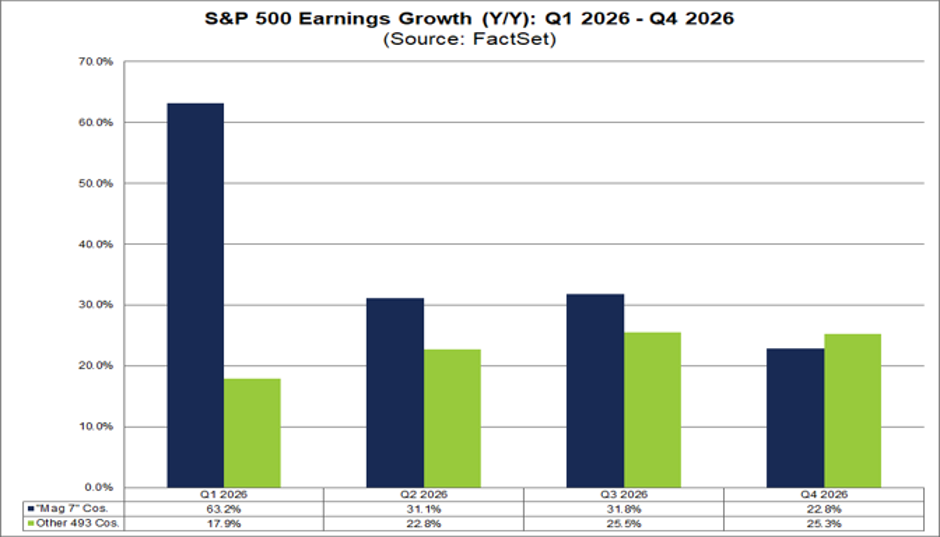
Chart one shows the annualised earnings growth that has been reported so far this year, and the projected growth for the remainder of 2026.
The dark blue bars show the earnings growth of the so-called “Magnificent Seven” (Mag 7) big tech stocks, whilst the green bars show the other 493 companies which make up the S&P 500 Index.
Source: Factset, 20 July 2026
We can see that in the first quarter, the Mag 7 saw earnings growth of over 60%. As we’ve discussed in the Pulse in June (The Pulse – June 2026 | Equilibrium), some of this reflects one-off factors. For example, the big tech stocks hold stakes in AI companies like OpenAI, Anthropic, as well as SpaceX, and those holdings have increased in value. This counts as “earnings”.
Whilst not quite as spectacular, the rest of the market has also seen strong growth, around 20% pa, and by the end of this year those other 493 stocks are projected to grow faster than the Mag 7.
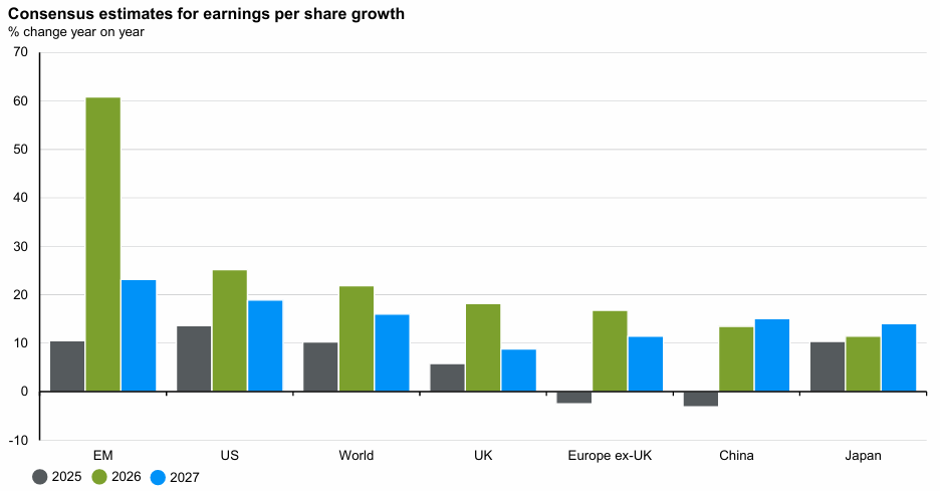
This broadening out of growth is not just confined to the US. Chart two shows earnings growth in the different regions for 2025, along with projected growth for 2026, and 2027.
Source: JPM Guide to Markets 31 July 2026
This time the standout is emerging markets, where the 60% expected growth is again AI related as big microchip manufacturers like TSMC and Samsung have an outsized effect.
However, we’re also expecting strong growth in every region, with the UK expected to grow at close to 20% and Europe at over 15% this year. Every region is projected to see at least 10% growth this year, although for most regions this might slow in 2027. China and Japan are exceptions, where growth is expected to accelerate into 2027.
This is a very healthy picture and makes us believe there are decent opportunities across various markets.
Market performance
This picture is also being reflected in stock market performance, where the Mag 7 are no longer dominating in terms of returns.
For example, chart three shows the returns of different parts of the stock market so far this year.
The main S&P 500 Index is in red, whilst the Mag 7 is in green. The big tech stocks have lagged, returning just under 3% compared to the market at 13%.
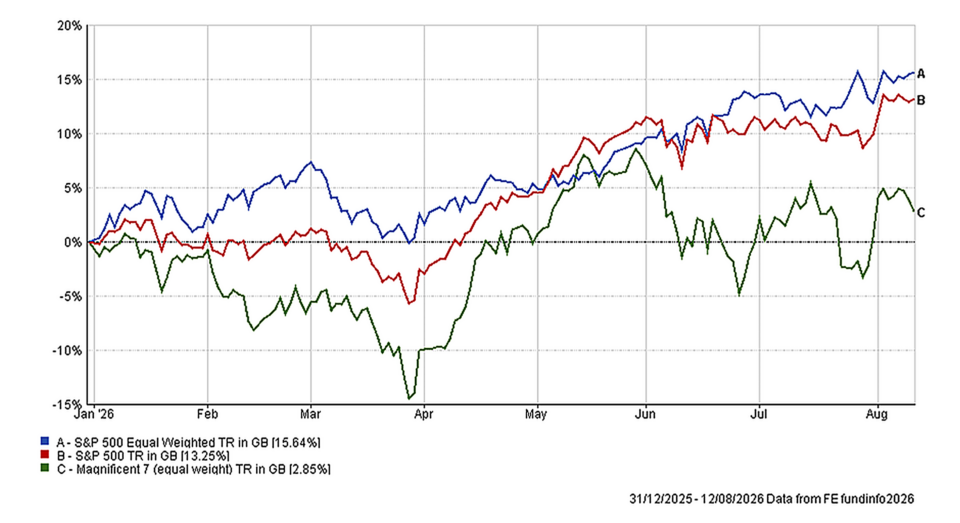
As discussed previously, the S&P 500 is heavily skewed towards the big tech stocks, as it is market capitalisation weighted and so assigns a greater weight towards bigger companies.
If we instead equal weight each stock in the top 500, we get the blue line. This has returned over 15%, showing the broadening out of growth into the smaller companies in the index. We invest a fair proportion of our US exposure in this way.
It’s not just the other parts of the US market which are outperforming. Equities outside of the US are outperforming too, with the MSCI World ex USA Index – which invests in all the biggest companies listed outside of the US – returning 13.87% so far this year, also ahead of the US market (source: FE Analytics, 31/12/25 to 12/08/26).
Emerging opportunities
When looking at expected earnings growth, we noted that only Japan and China are expected to see higher growth in 2027 than they are seeing this year.
We also happen to believe that both markets look relatively good value compared to the profits of the underlying companies. As a result, we’ve recently increased exposure to Japan in all our main portfolios, and to China in our higher risk Global Equity portfolio.
Both of these have been achieved through structured products.
In the case of Japan, we have invested via a defined returns product. You may be familiar with these products which we’ve invested in for a long time. Primarily, we’ve invested in products linked to the FTSE 100 and/or the S&P 500 index or Euro Stoxx 600. The attraction of such products is that they can provide a relatively high, usually double-digit return, without the need for market growth.
By linking a product to the Nikkei 225 Index in Japan as well as the FTSE 100, we can get a better rate of return from a similar structure.
On Balanced, Adventurous and Global Equity, we’ve invested in a five-year product which could provide a return of 17.05%. This was funded by reinvesting the proceeds of a FTSE/Euro Stoxx product, which recently kicked out (matured). For comparison purposes, this had an 11.32% headline return.
This return will be achieved provided both the FTSE and Nikkei indexes are at or above their starting levels at any of the first five anniversaries of the product’s launch. In the event one or both markets go down over five years, there’s an element of capital protection as with all the previous products we’ve used.
On Defensive and Cautious, we’ve invested in a lower risk version of this product, where the kick out level drops by 5% a year. This could provide 12.3% pa, even if the market drops by 5% over the first year. It can still provide this return even if markets are down by up to 25% over five years.
Japan has historically been a volatile market with more periods of negative returns than the UK or US. That’s why we get offered a higher rate of return. However, we have a positive outlook for this market and think that at these levels this has a very attractive balance of risk and potential return.
The China investment differs slightly. It is a six-year product with capital protection if markets fall over the term, similar to our other defined returns products. However, unlike those products, it cannot kick out early.
This will provide a return of 5.75 times the return of the Chinese CSI 300 market over the term, to a maximum of 230% return (which would be achieved if the market went up 40% or more over 6 years). Whilst it is a fixed term product, we can buy or sell it on any day, with the movement of the Chinese market determining the price.
Because of that “gearing”, it will be very volatile and so it is only a small holding in our riskiest fund. However, due to the way it works it could have an outsized effect on returns.
As with all the structured products we invest in, one of the benefits is the relatively predictable behaviour. We can back-test how the product would have worked in the past, by looking at the historic returns of the market.
Before we invested, we compared the product with the returns of a Chinese index tracker, and with the wider emerging market index.
This showed that the structured product would have outperformed the other two investments in 74% of the six-year periods in our data set; 20% of the time you would have been better off investing in a wider emerging market fund, and only 6% of the time would you have been better off buying a China index tracker.
This data shows that the product not only seems likely to work well, but that when it does, the returns are typically substantially higher than the alternatives.
We are always looking at ways to skew the odds in our favour – to enhance returns or provide a greater return relative to risk. We think these products can help us achieve it, as well as benefiting from the growth in companies in different markets around the world.
Past performance is for illustrative purposes only and cannot be guaranteed to apply in the future.
This newsletter is intended as an information piece and does not constitute investment advice.
If you have any further questions, please don’t hesitate to get in touch with us on 0161 486 2250 or reach out to your usual Equilibrium contact.
New to Equilibrium? Call 0161 383 3335 for a free, no-obligation chat or contact us here.